If your team lives and dies by developer velocity, cost predictability, and API automation, Cloudflare’s edge-scale approach usually fits better. If you’re running a regulated enterprise where inline data loss prevention, native deception, and audit depth matter more than speed, Zscaler’s security-depth model tends to win. Most organizations sit somewhere between those two poles, which is exactly why a proof-of-concept beats a sales pitch.
Before signing anything, run a scoped PoC against your own traffic and users. A solid PoC checks:
- Latency target: measure end-to-end response time for your real applications, not synthetic benchmarks.
- DLP detection test: feed representative sensitive files through the platform and confirm accurate flagging.
- Policy management and visibility: score how easily your team can write, audit, and log access policies.
Standards like SOC 2, DLP frameworks, and IAM/IdP integration should anchor your scoring criteria. ArchiTECH MSP builds this kind of validation into every managed security engagement, because a platform decision this size deserves evidence, not a demo.
Key Takeaways
The right platform depends entirely on whether your organization values edge performance and cost flexibility or deep inline security and regulatory certification coverage.
| Point | Details |
|---|---|
| Match platform to profile | Edge-scale fits cost-sensitive, devops-driven teams; security-depth fits regulated enterprises needing FedRAMP High or advanced DLP. |
| Run a scoped PoC | Test real latency, DLP detection accuracy, and policy management usability before committing to either category. |
| Budget beyond licensing | Professional services, private interconnects, and long-term SIEM log storage often exceed the license cost itself. |
| Verify certifications explicitly | Confirm SOC 2, ISO 27001, PCI, and HIPAA coverage, and check FedRAMP High if you serve government workloads. |
| Consider managed deployment | An MSP with a documented security framework can shorten compliance timelines and absorb PoC and rollout risk. |
Cloudflare vs Zscaler: Comparing Performance, Security Depth, and Cost
Vendor marketing aside, the two platforms optimize for different things, and the data backs that up.
Performance and edge footprint. Independent benchmarks measured Zero Trust experience improvements in the 38 to 55 percent range when traffic ran over a large anycast network instead of a smaller point-of-presence footprint. One edge-scale network reports 330-plus cities and roughly 477 Tbps of capacity, while a security-specialist SSE network reports around 150 PoPs processing hundreds of billions of daily transactions. Both numbers are large. They just serve different priorities: raw geographic reach versus concentrated inspection capacity.
Statistic callout: Latency-sensitive apps saw the biggest gains from broader anycast coverage, according to Cloudflare’s own performance benchmarking, making edge footprint a legitimate line item in any RFP scoring sheet.
Security feature depth. “Depth” here means the number and sophistication of inspection layers: secure web gateway, ZTNA, CASB, DLP, sandboxing, and native deception technology that lures attackers into fake assets. Platforms built around security inspection tend to offer deeper DLP (including exact data matching and indexed document matching), CASB API coverage, and inline TLS inspection, while edge-scale platforms lean toward local enforcement, developer-facing APIs, and consolidating multiple network functions on one control plane, according to independent comparison research.
Deployment models differ structurally. One approach uses outbound agents or daemons that reach out from the device to the cloud, which avoids opening inbound firewall ports. The other often relies on inside-out connectors deployed near your applications, which changes how you manage hosting, connector patching, and network segmentation. Neither model is wrong. They just create different operational habits for your network team.

Compliance and certifications. Verify SOC 2, ISO 27001, PCI, and HIPAA coverage for either category, since analyst comparisons confirm both generally hold these. The gap shows up at the top: some security-specialist platforms carry FedRAMP High authorization, which matters if you serve government workloads or contractors under CMMC.
Pricing shape. One category offers freemium access up to 50 users and pay-as-you-go pricing near $7 per user monthly. The other typically runs quote-based, tiered enterprise licensing that scales with feature depth and support tier. Treat any published range as illustrative, not a guarantee, until your own quote arrives.
How Do You Choose Between Cloudflare and Zscaler?
Score any shortlist against a fixed checklist before you fall for a slick demo:
- Performance under your real traffic — not a vendor’s lab conditions.
- Compliance certifications that match your regulatory obligations, including FedRAMP High if you touch government data.
- Feature coverage for DLP, CASB, and sandboxing relative to what your data actually requires.
- Log access and retention — can your SIEM ingest everything you need, and for how long?
- Manageability — how many clicks does it take to write and audit a policy?
- Total cost of ownership, including the services and integration work nobody mentions upfront.
Four buyer profiles tend to recur. SMB and devops-first teams should weight cost and API automation above everything else. Mid-market companies without dedicated security staff should weight ease of management and vendor support responsiveness. Regulated enterprises in healthcare, finance, or defense should weight DLP depth and FedRAMP High availability as near-disqualifiers if absent. Multinational organizations with a distributed workforce should weight edge footprint and consistent global latency.
Pro Tip: Walk away from any vendor that won’t hand over sample logs or a sandbox environment before contract signature. Opaque pricing, vague SLA language, restricted log access, and missing compliance certifications are the four fastest ways a promising shortlist turns into a stalled project.
What Does a Real Deployment Timeline Look Like?
Expect three phases: a two to four week PoC, a 30 to 60 day pilot with a limited user group, and a phased production rollout that can stretch several months for larger enterprises. You’ll need a network engineer to handle connector and firewall changes, an identity administrator to wire up your IdP, and a security analyst to validate policy logic and log output.
Integration touchpoints to map out early:
- Identity provider (Okta, Entra ID, or similar) for single sign-on and conditional access.
- SIEM ingestion for centralized log correlation and incident response.
- MDM or endpoint management for device posture checks.
- CASB API coverage for the SaaS apps your business actually runs, particularly Microsoft 365 and Azure environments.
Once live, plan for ongoing policy lifecycle management, formal change control before any access rule shifts, and a support model that matches your internal team’s bandwidth. None of this is a “set it and forget it” purchase.
What Does Pricing and ROI Actually Look Like?
Pricing follows two shapes: per-user pay-as-you-go with a usable free tier, or tiered enterprise licensing that requires a custom quote. The PAYG model reduces procurement friction for smaller teams, since staged rollouts are genuinely cost-effective compared with a large upfront enterprise contract.
Two rough sketches:
- Mid-market, 250 users: a PAYG model near $7 per user monthly lands around $21,000 annually before add-ons; an enterprise quote-based tier could run higher depending on DLP and support levels.
- Enterprise, 5,000 users: quote-based licensing dominates, with the real cost driver being feature tier and integration scope, not headcount.
Budget separately for professional services, private interconnects, and long-term log storage feeding your SIEM, since operational costs beyond the license fee routinely exceed first estimates. For the ROI conversation with leadership, frame it around reduced breach exposure, faster compliance audits, and fewer help desk tickets tied to VPN failures.
When Should You Bring In a Security-First MSP?
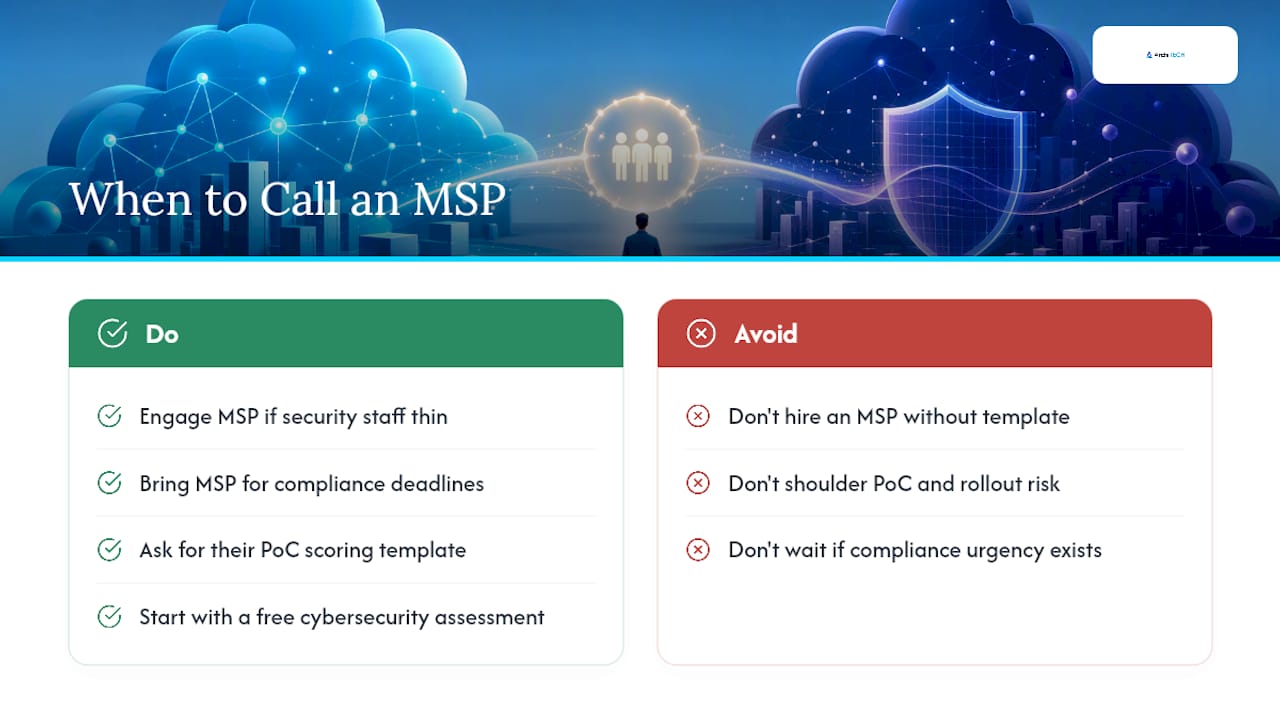
Not every organization has the internal bandwidth to run a proper PoC, negotiate enterprise pricing, and manage policy lifecycle afterward. If your team is thin on dedicated security staff, facing a compliance deadline, or simply doesn’t want to own PoC and rollout risk alone, a managed partner earns its fee fast.
ArchiTECH MSP built its practice around a structured six-step security framework, supporting HIPAA and PCI compliance work, and covering Microsoft 365 and Azure cloud security alongside free cybersecurity assessments delivered with a proactive, security-first approach.
Pro Tip: Ask any MSP candidate to walk you through their own PoC scoring template before you sign. If they can’t produce one, they’re guessing right alongside you.
An experienced partner shortens time-to-compliance during migrations because they’ve already built the in-house versus managed security tradeoff analysis your team is doing for the first time.
If your organization is weighing a Zero Trust migration against a compliance deadline, ArchiTECH MSP’s cybersecurity services are built specifically around HIPAA, PCI, and CMMC readiness for small and mid-sized businesses in regulated industries. A free cybersecurity assessment is the lowest-friction way to find out whether a managed deployment path saves you the PoC headache entirely. Organizations further along in a SASE evaluation may also want to compare notes with a managed FortiSASE offering to see how a third approach stacks up against both edge-scale and security-depth categories.
Why Procurement Teams Get This Comparison Wrong
Most write-ups treat this decision like a feature checklist contest, tallying who has more acronyms next to their name. That misses the point entirely. The real question is whether your organization’s risk profile and staffing reality match what each platform category assumes about you.
Conventional advice leans hard on “just pick the market leader,” which ignores that a 12-person devops shop and a 5,000-employee hospital system have almost nothing in common operationally. The edge-scale versus security-depth framing holds up better than any vendor scorecard because it starts from your constraints, not the vendor’s roadmap slide.
What gets underweighted almost everywhere: the hidden operational cost of policy lifecycle management after go-live. Nobody budgets for the analyst hours spent auditing access rules six months in, and that’s where PoCs should spend more time, not less. Prioritize your PoC around what breaks at month six, not what looks good in week one.
— Tyson
Sources
- Gartner Peer Insights — Cloudflare vs Zscaler
- Defend
- SoftwareAdvice — Cloudflare vs Zscaler comparison
FAQ
Who Are Zscaler’s Biggest Competitors?
Zscaler competes primarily with other security service edge and Zero Trust platforms that emphasize inline inspection depth, including offerings from major cloud and network security vendors, alongside edge-scale platforms like Cloudflare that compete on performance and pricing.
Who Is Cloudflare’s Biggest Competitor?
Cloudflare’s closest competitive category includes other large content delivery and edge security networks, plus security-specialist SSE platforms like Zscaler that compete on inspection depth rather than raw network footprint.
Is Zscaler Bad?
No credible evidence supports that claim. Gartner Peer Insights shows strong ratings across capability dimensions, and independent comparisons consistently recommend it for regulated enterprises needing deep DLP and FedRAMP High authorization.
Does the US Government Use Cloudflare?
Government and regulated-industry usage depends on certification level. Analyst comparisons note that some security-specialist platforms hold higher federal authorizations like FedRAMP High, which matters more for certain regulated workloads than general market presence.
Recommended
- Microsoft 365 & Azure Cloud Security | ArchiTECH MSP
- ArchiTECH MSP | Security-First Managed IT | New Bedford, MA
- In-House IT vs. Managed Security | ArchiTECH MSP
- Free Cybersecurity Assessment | ArchiTECH MSP | New Bedford, MA