A CMMC System Security Plan is the assessor-facing document that defines your CUI boundary, describes how every applicable NIST SP 800-171r3 requirement is actually implemented, names an owner for each control, and points to evidence proving it operates as intended. If you’re starting from zero, your first moves are simple: confirm your required CMMC level, find every place CUI lives in your environment, and start collecting the evidence you’ll need before an assessor ever asks for it.
TL;DR:
- A thorough SSP clearly defines your CUI boundary, accurately documents how each NIST SP 800-171 control is implemented, and maintains an up-to-date evidence index for swift review.
- Discrepancies between asset inventories, network diagrams, and control narratives are a common cause of assessor pushback, making consistent artifact reconciliation crucial.
- Outside providers handling security functions must be explicitly documented, with clear responsibility lines, delivered services, and direct references to supporting evidence.
- Regular updates and immediate revisions after any material environment change are essential to keep your SSP audit-ready and prevent outdated or mismatched documentation.
- Most failures originate from inconsistent, generic, or incomplete documentation rather than missing controls, emphasizing the importance of environment-specific, well-organized records.
What Is a CMMC SSP and Why Does It Matter?
An SSP is not a policy binder. It’s a working record of your actual environment. Under NIST SP 800-171 Rev. 3, the SSP has to identify your assessment scope and system boundary, describe how your systems and networks actually relate to each other, list every applicable security requirement, and explain how each is implemented in your specific environment, not a generic one. That last part trips up more contractors than anything else.
Here’s the distinction that matters most: a policy tells people what they’re supposed to do. An SSP tells an assessor what your systems are actually doing right now, who’s responsible, and where the proof lives. Those are different documents serving different purposes, and CMMC Level 2 assessments live and die on that difference.
The 32 CFR part 170 regulation is what makes this contractual rather than optional. It codifies CMMC statuses and phases requirements into DoD solicitations, which means your SSP obligation traces directly back to your contract language, not just good security hygiene.
Three documents get confused constantly, so keep them separate in your head:
- Policies and procedures describe intended behavior across your organization.
- The SSP describes how those policies actually manifest, technically and operationally, in your systems today.
- The POA&M tracks what’s not yet implemented, with dates and owners for closing the gap.
An assessor reading your SSP is checking whether your narrative matches your environment. Nothing more, nothing less.
What Does an Assessor Expect Inside the SSP?
Assessors work from a checklist, whether they say so explicitly or not. Building your SSP around that checklist saves you weeks of rework later.
- Scope and system boundary. Define exactly which assets, networks, and facilities fall inside your CUI boundary. The CMMC Scoping Guide for Level 2 categorizes assets as CUI assets, Security Protection Assets (SPAs), or specialized assets, and every one needs to land in the right bucket consistently across your documentation.
- Asset inventory and diagrams. A current list of hardware, software, and data flows, paired with a network diagram and a CUI-flow diagram showing where regulated data enters, moves, and exits your systems.
- Control narratives per requirement. For each applicable NIST SP 800-171r3 control, write what’s implemented, who owns it, how often it runs, and where the evidence sits.
- Evidence index. A running list of configuration exports, access review logs, patch reports, and screenshots that back up every narrative claim.
- POA&M cross-reference. Anything not fully implemented gets flagged here, with a target date, instead of buried inside a control narrative pretending to be finished work.
One scoping decision drives everything downstream: a tighter boundary reduces your assessment burden, but an artificially narrow one that ignores connected assets creates real audit risk, a point the Scoping Guide is explicit about.
Pro Tip: Build your evidence index as a spreadsheet with one row per requirement and a direct file link or path in the next column. When an assessor asks “show me,” you want an answer in seconds, not a scavenger hunt through shared drives.
How Do You Build an Audit-Ready SSP Step by Step?
Most contractors try to write the SSP narrative first and figure out scope later. That’s backward, and it’s why so many drafts need a full rewrite three weeks before an assessment.
- Confirm your required CMMC level and map to NIST SP 800-171r3. Your contract language dictates the level; don’t guess.
- Locate your CUI and draw the boundary. Walk through every system, decide what handles CUI, and choose between an enclave approach (isolating CUI to fewer systems) or an enterprise-wide scope.
- Inventory assets, SPAs, and outside providers. List every device, cloud service, and managed provider touching your CUI boundary, and produce your network and data-flow diagrams from that list, not the other way around.
- Map each requirement to implementation, owner, frequency, and evidence. Work through the NIST SP 800-171r3 catalog line by line rather than copying boilerplate language.
- Assemble your evidence index and run a traceability check. Pull every artifact referenced in your narratives and confirm it actually exists and actually matches what the narrative claims.
- Separate anything unfinished into the POA&M. Planned work stays in the POA&M with dates. It never gets written into the SSP as if it’s already done.
- Assign ownership and set your update cadence. Name a person, not a department, for scope decisions and evidence maintenance.
- Run a pre-assessment review. Have someone outside the drafting team read the SSP cold and flag anything that doesn’t match reality.
The CMMC Assessment Guide for Level 2 spells out that assessors use examine, interview, and test methods, meaning they’ll read your document, talk to your staff, and check whether controls actually operate the way you described. All three have to agree.
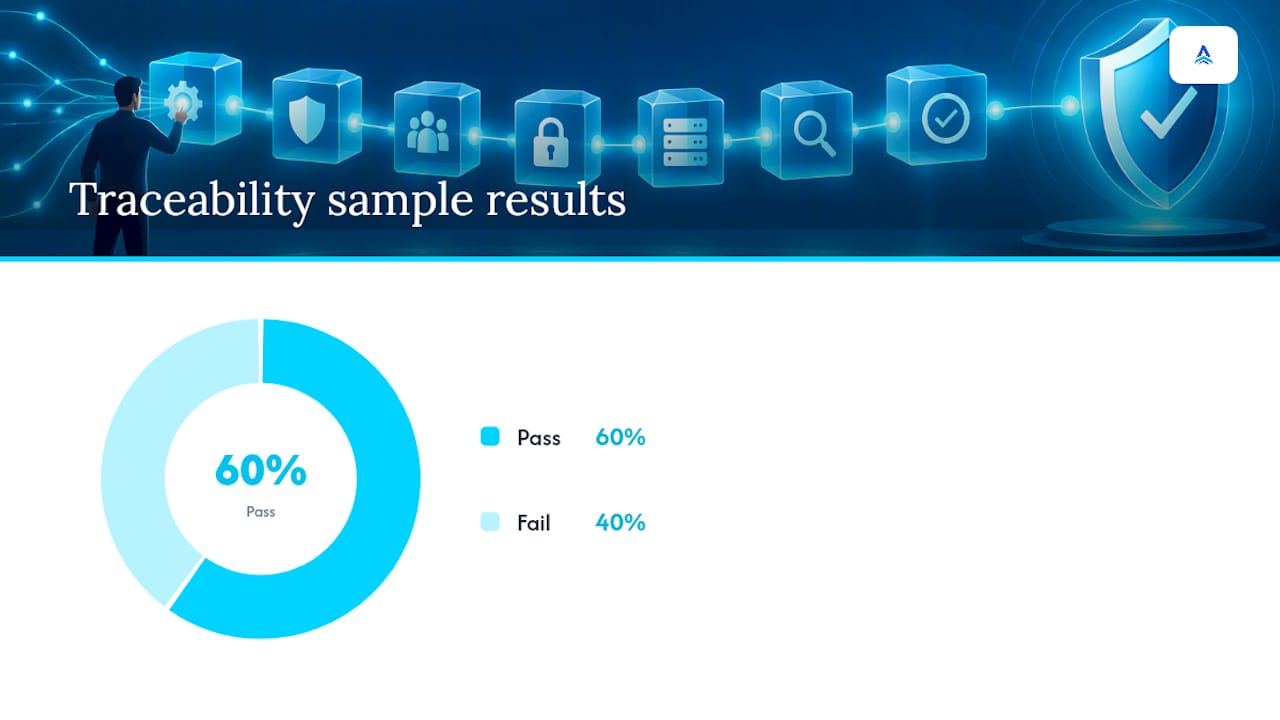
Pro Tip: Do the traceability check yourself before an assessor does it for you. Pick five requirements at random, pull the referenced evidence, and see if it holds up. If two out of five fail, you’ve found your real timeline problem.
What Mistakes Sink an Otherwise Solid SSP?
The failures aren’t usually about missing controls. They’re about documentation that doesn’t hold together under scrutiny.
- Inconsistency across artifacts. Your asset inventory lists 40 devices, your network diagram shows 35, and your control narratives reference a system that isn’t in either. Reconcile every artifact against every other one before you consider the SSP finished, since this mismatch is the single most common cause of assessor pushback, according to the CMMC Scoping Guide.
- Generic template language. NIST doesn’t mandate a specific format, but a narrative that reads like boilerplate copied from a downloaded template signals to an assessor that nobody actually checked whether it’s true. Replace every generic sentence with an environment-specific fact: not “access is restricted,” but “access to the CUI file server is limited to six named accounts, reviewed quarterly by the IT lead.”
- Using the POA&M to hide gaps. A control that isn’t implemented yet belongs in the POA&M with a target date, not written into the SSP as if it’s operational. NIST guidance is direct on this: planned remediation and current operating state are not interchangeable.
- Undocumented provider responsibility. If a cloud platform or managed provider handles part of a control, the SSP has to state who does what. A vague “vendor handles security” line will not survive an interview.
- Missing or unindexed evidence. Evidence that exists somewhere but isn’t linked or labeled slows an assessment to a crawl, even when the underlying control is genuinely solid.
How Do You Document ESPs, Cloud Services, and SPAs?
Any outside provider touching your CUI boundary or supplying a security capability needs a clear paper trail. Outsourcing a function doesn’t remove your obligation to show how the requirement is satisfied; it just changes who’s performing the work.
- Determine ESP or SPA status first. If a provider delivers a security function like SIEM, EDR, or MFA, it typically qualifies as a Security Protection Asset and needs to be documented as one, including the Security Protection Data it generates.
- Capture the specifics for each provider: the services delivered, which assets they touch, how data flows to and from them, and exactly where the responsibility line sits between your team and theirs.
- Point to third-party evidence directly. If a provider’s own audit report or configuration export backs a control, reference that document by name and location rather than describing it in vague terms.
- Map responsibility, not just vendor names. For managed security or cloud arrangements, spell out who configures the tool, who monitors it, and who retains the resulting logs. A vendor logo in the SSP proves nothing on its own.
How Do You Keep an SSP Audit-Ready Over Time?
An SSP that was accurate at signing is worthless eighteen months later if nobody touched it. The CMMC Assessment Guide treats annual review as a baseline, but the real trigger is change, not the calendar.
- Update on a fixed annual cycle at minimum. Put a date on the calendar and treat it as non-negotiable.
- Update immediately after material changes. New systems, a new cloud provider, a network redesign, or a staffing change in a control-owner role all require an update the same month it happens, not at the next scheduled review.
- Track POA&M items to actual closeout. A POA&M item isn’t done when someone says it’s done. It’s done when the evidence showing the control operating exists in your index.
- Retain evidence with dates and version history. A screenshot with no date attached is close to useless a year later; an assessor needs to see when a control was actually checked.
- Assign named owners, not departments. “IT” is not an owner. A specific person accountable for scope decisions and evidence collection is.
Pro Tip: Set a recurring 90-day mini-review, even outside your annual cycle. Fifteen minutes checking whether your asset inventory still matches reality catches drift long before it becomes a scramble.
The ArchiTECH Perspective on Building a Defensible SSP
Most SSP failures I’ve seen trace back to treating it as a writing exercise instead of an operations exercise. A six-step security framework maps scoping, asset inventory, control implementation, and evidence collection to concrete technical work rather than a document draft.
For small and mid-sized defense contractors, that matters because enterprise-grade compliance work usually assumes an enterprise budget and an in-house compliance team neither has. Backed by a track record of zero major security incidents, structured, framework-driven practices scaled to what an SMB can actually staff and afford are applied.
If your team would rather have hands-on support building traceable narratives and evidence packages than do it all independently, that’s a conversation worth having early, not two weeks before an assessment window opens.
— Tyson
Get Hands-On Help Building Your CMMC SSP
Writing a defensible SSP alongside your regular IT workload is where most SMB defense contractors lose time, not in understanding the requirements. ArchiTECH’s compliance services cover the parts that actually eat weeks: mapping NIST SP 800-171r3 requirements to your real environment, packaging evidence so it survives assessor scrutiny, managing POA&M items so nothing gets buried, and running a pre-assessment check before you’re staring down an actual audit date.

The approach centers on security-first managed IT built for New England small and mid-sized organizations, including manufacturers and defense contractors who can’t staff a full compliance department but still need enterprise-grade discipline. That framework also feeds directly into evidence generation: cybersecurity services like penetration testing, EDR/MDR, and security awareness training don’t just harden your environment, they produce the exact logs and reports your SSP evidence index needs.
If you’re not sure where your current SSP stands or you’re starting from nothing, request a free cybersecurity assessment and get a clear read on your gaps before an assessor finds them for you.
Sources
Don’t build an SSP from secondhand summaries. Go to the primary sources directly:
- NIST SP 800-171 Rev. 3
- PART 170—Cybersecurity Maturity Model Certification (CMMC) Program (32 CFR part 170)
- CMMC Scoping Guide – Level 2
For contractors tracking implementation timing, this CMMC 2.0 action summary and this vendor compliance checklist both offer useful supplementary context on current obligations and documentation practices.
FAQ
Is an SSP Considered CUI?
An SSP itself typically is not CUI, but it often describes your CUI environment in enough detail that it should be handled as sensitive internal information. Store it with the same access controls you’d apply to other sensitive operational documentation, and check your specific contract language for any marking requirements.
What Is an SSP in Relation to CMMC?
An SSP is the document that shows how your organization implements every applicable NIST SP 800-171r3 requirement inside your defined CUI boundary. For CMMC Level 2, it’s the central artifact assessors review to verify that controls are implemented and actually operating, not just described.
Where Can I Find the NIST SSP Template?
NIST hosts a downloadable SSP template you can adapt to your environment. NIST doesn’t mandate this exact format, so treat it as a starting structure that still needs to be filled with your organization’s specific implementation details, not generic language.
Is CMMC Required Now?
CMMC requirements are being phased into DoD solicitations and contracts under 32 CFR part 170, so whether it applies to you right now depends on your specific contract language and its solicitation date. Check your contract clauses directly, or work with a compliance-focused provider like ArchiTECH to confirm your exact timeline.