A cyber tabletop exercise is a discussion-based drill where decision-makers walk through a simulated attack, like ransomware or a cloud outage, and talk through their response in real time. The single most effective move you can make is to run a focused session lasting about an hour and a half to two hours with actual decision-makers in the room, using a template like CISA’s Tabletop Exercise Packages, and commit to finishing the after-action report promptly.
TL;DR:
- Running a tabletop exercise with decision-makers in a focused 90 to 120-minute session significantly improves response readiness and accountability.
- Clear objectives, scope boundaries, and measurable success criteria are essential to prevent wasted time and ensure meaningful outcomes.
- Including both executive authorities and technical staff in the room enhances decision-making speed and operational understanding during crises.
- Delivering a timely, detailed after-action report within 48 hours is crucial for tracking identified gaps and ensuring follow-up actions are completed.
- Using real vendor names, specific scenarios, and reputable frameworks like MITRE ATT&CK increases the realism and effectiveness of the exercise.
Cyber Tabletop Exercise Checklist and 90-Minute Agenda
Copy this into your next planning meeting. Most organizations overthink the setup and underthink the follow-through, so keep the prep lean and protect time for the debrief.
Before the meeting:
- Write one objective sentence (what decision are you testing?).
- Set scope boundaries (which systems, vendors, and business units are in play).
- Build the invite list around decision-makers, not just IT staff.
- Send a one-page pre-read so nobody wastes time getting oriented.
During the session (90 to 120 minutes):
- Set the scene, five minutes.
- Deliver the first inject, then run 20 to 30 minutes of discussion per inject cycle.
- Reserve the final 20 minutes strictly for debrief.
- Assign gap owners and dates before anyone leaves the room.
Bring a whiteboard or shared doc, a visible clock, and your incident response plan. Walk out with a named owner and a deadline attached to every gap you find.
How Do You Set Objectives for a Tabletop Exercise?
A cyber tabletop exercise without a sharp objective can turn into an unproductive conversation lasting a significant amount of time. Before you touch a scenario, decide exactly which decision or capability you’re testing. That single choice shapes everything else, including who gets invited and how you measure success.
Strong objectives read like test questions, not mission statements:
- Can leadership decide whether to pay a ransom within 60 minutes of confirmed encryption?
- Do we know which vendors we depend on for recovery, and do we have their contact escalation paths on hand?
- Can we hit our stated recovery time objective, or does the plan assume resources we don’t actually have?
Scope follows the objective. If you’re testing a ransomware response, define which systems, business units, and third-party vendors are in bounds, and say explicitly what’s out. Logistics decisions matter too: remote sessions work fine for discussion-based exercises, but in-person sessions tend to surface body-language cues, like the hesitation before someone admits they don’t know who owns backup verification, that a video call misses.
Success criteria should be measurable, not vibes-based. “We identified three gaps with owners and dates” beats “everyone found it valuable.”
Who Should Be in the Room for an Incident Response Tabletop?
The most common failure in a ransomware tabletop exercise is inviting only technical staff. If nobody in the room can authorize a ransom payment, approve a public statement, or sign off on shutting down a production line, you’re testing knowledge, not readiness.
- Executive sponsor — holds authority to make the calls the scenario forces (pay/don’t pay, shut down systems, notify regulators).
- Incident lead — owns the response plan and drives the narrative through each decision point.
- IT and security staff — provide technical ground truth on what’s actually recoverable and how fast.
- Legal counsel — flags breach notification obligations and liability exposure as they arise.
- PR or communications lead — drafts and stress-tests external messaging under time pressure.
- Finance representative — weighs in on ransom payment logistics or vendor payment disruptions.
- Facilitator — runs the clock, delivers injects, and keeps the group from wandering into the weeds.
- Scribe and evaluators — capture decisions, timestamps, and unresolved questions for the AAR.
Observers can sit in, but keep the active seat count tight. Who you invite determines what you’re actually testing: a room full of executives validates authority and communication; a room full of engineers validates technical recovery steps. You need both eventually, but rarely in the same 90 minutes.
Building Scenarios and Injects That Force Real Decisions
Pick a scenario that maps directly to your stated objective. Ransomware tests recovery decisions and vendor dependencies. A cloud compromise (Microsoft 365 or Azure, for instance) tests identity and access response. Business email compromise tests financial controls. An industrial control system compromise tests physical safety and operational continuity. Don’t run a generic scenario just because it’s available; match it to what you actually need to learn.
Realism comes from specifics. Use your real backup vendor’s name, your real EDR platform, your real payroll processor. A scenario that says “a critical vendor” instead of naming the actual vendor lets participants mentally shrug it off.
Injects work best delivered one at a time, each one forcing a decision rather than reciting a fact:
- Announce a restore time estimate of nine days when the business assumed 24 hours, and watch the recovery conversation get real fast.
- Have finance ask, mid-exercise, whether to wire the ransom before legal has weighed in.
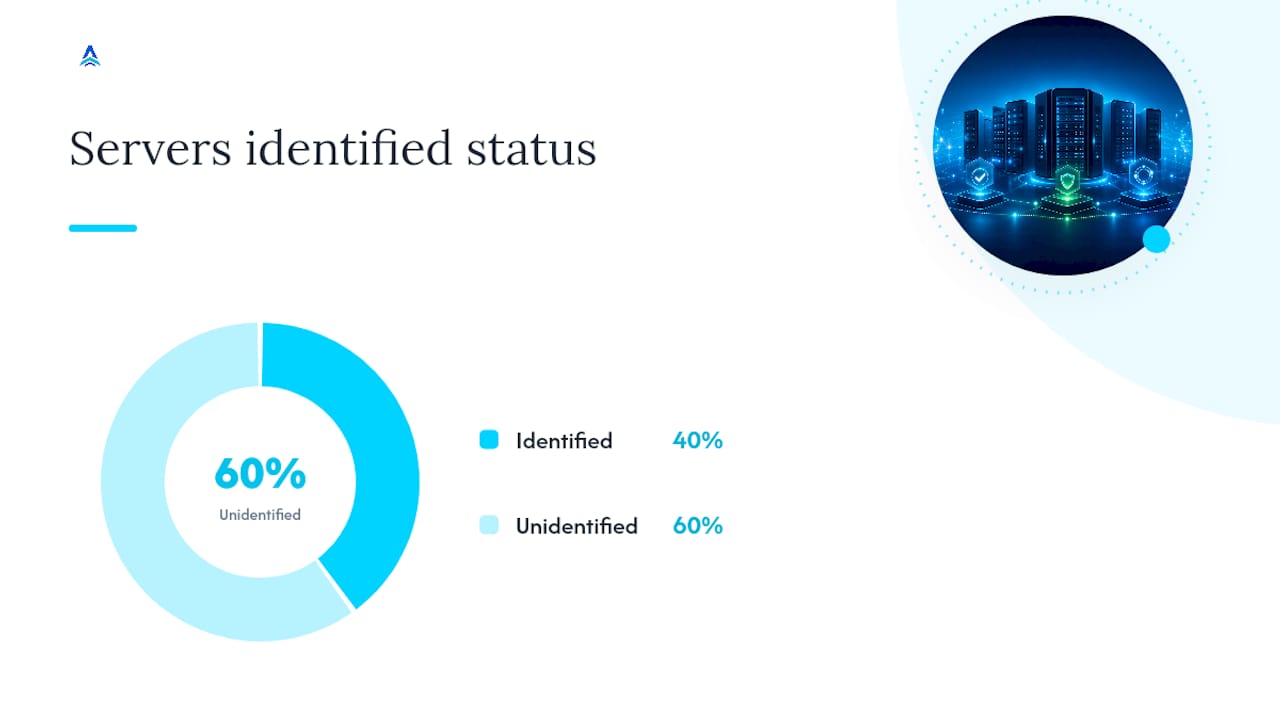
- Drop a partial detail (only two of five affected servers identified so far) to test how the team handles uncertainty.
- Introduce a reporter’s inquiry to test the communications timeline against the legal disclosure clock.
MITRE ATT&CK and scenario libraries like Backdoors & Breaches are solid sources for realistic attacker behavior when you’re short on inject ideas.
What Makes a Tabletop Exercise Facilitator Effective?
Facilitation is where most exercises either earn their keep or collapse into a policy-recitation session. Three rules keep things on track: no blame when someone doesn’t know an answer, no releasing the full scenario upfront, and keep the clock visible at all times so time pressure stays real.
Deliver injects one at a time and announce the simulated time jump between them (“It’s now been four hours since detection”). This keeps the group reacting to a moving situation instead of debating a static hypothetical, and practitioner guidance consistently points to this incremental delivery as the difference between a useful exercise and a talking-points meeting.
Push for actions, not answers. If someone says “our policy covers this,” ask them to open the actual document and read the relevant line. Half the time, the policy doesn’t say what people assumed.
Pro Tip: Keep a running “we need to check on this” list visible to everyone during the session. Every item on that list becomes a tracked task with an owner before the meeting ends, not a vague follow-up nobody remembers by Friday.
- Enforce the clock. A tabletop that runs long loses its urgency.
- Capture uncertainty live rather than letting it evaporate into “we’ll figure it out later.”
- Redirect policy talk into concrete action.
Turning Tabletop Findings Into Tracked Remediation
The exercise itself is the easy part. The after-action report is where the value either gets captured or quietly disappears.
A solid AAR includes:
- An executive summary written for people who weren’t in the room.
- The scenario and objectives tested.
- Specific findings, including what worked and what didn’t.
- Recommended actions tied to each finding.
- Named owners and hard deadlines for every action.
Complete the AAR within 48 hours. Momentum drops fast once the exercise fades from memory, and a delayed report tends to lose the specific details that made the findings useful in the first place. This speed also matters for compliance: HIPAA, PCI DSS, and CMMC assessors increasingly expect documented, dated evidence that gaps were identified and closed, not just that an exercise happened.
Assign owners with deadlines, then schedule the next tabletop before everyone scatters. A remediation tracker that gets reviewed monthly turns a one-off exercise into an actual security program. Present findings to leadership in plain terms: what broke, who’s fixing it, and by when.
Where to Find Tabletop Exercise Templates and Scenario Libraries
Start with CISA’s CTEP packages, which include over 100 customizable scenario modules, slide decks, discussion questions, and AAR templates covering ransomware, phishing, insider threats, and sector-specific situations like healthcare and elections infrastructure.
- Pull the NIST CSRC glossary definition and NIST SP 800-84 guidance for the underlying framework and terminology.
- Use MITRE ATT&CK and Backdoors & Breaches for realistic attacker behavior when building injects.
- Store your customized version in a shared drive with version control, and swap in your real vendor and system names.
- For payment-heavy environments, PCI-focused security guidance helps when scenarios touch payment systems.
How ArchiTECH MSP Runs Tabletop Exercises for SMBs
Tabletop exercises are baked into ArchiTECH’s six-step security framework, not treated as an annual checkbox. We build a scenario custom to the client’s environment, facilitate the session, and deliver an AAR with prioritized remediation, usually within that 48-hour window.
If your team has never run a tabletop before, or your last one produced a list nobody acted on, bringing in outside facilitation tends to surface more honest answers than running it entirely in-house.
What the Research Actually Supports
Most advice on cyber tabletop exercises spends too much time on scenario creativity and not enough on follow-through discipline. A clever ransomware scenario with a slick slide deck means nothing if the gaps it surfaces sit in a shared doc for three months with no owner attached.
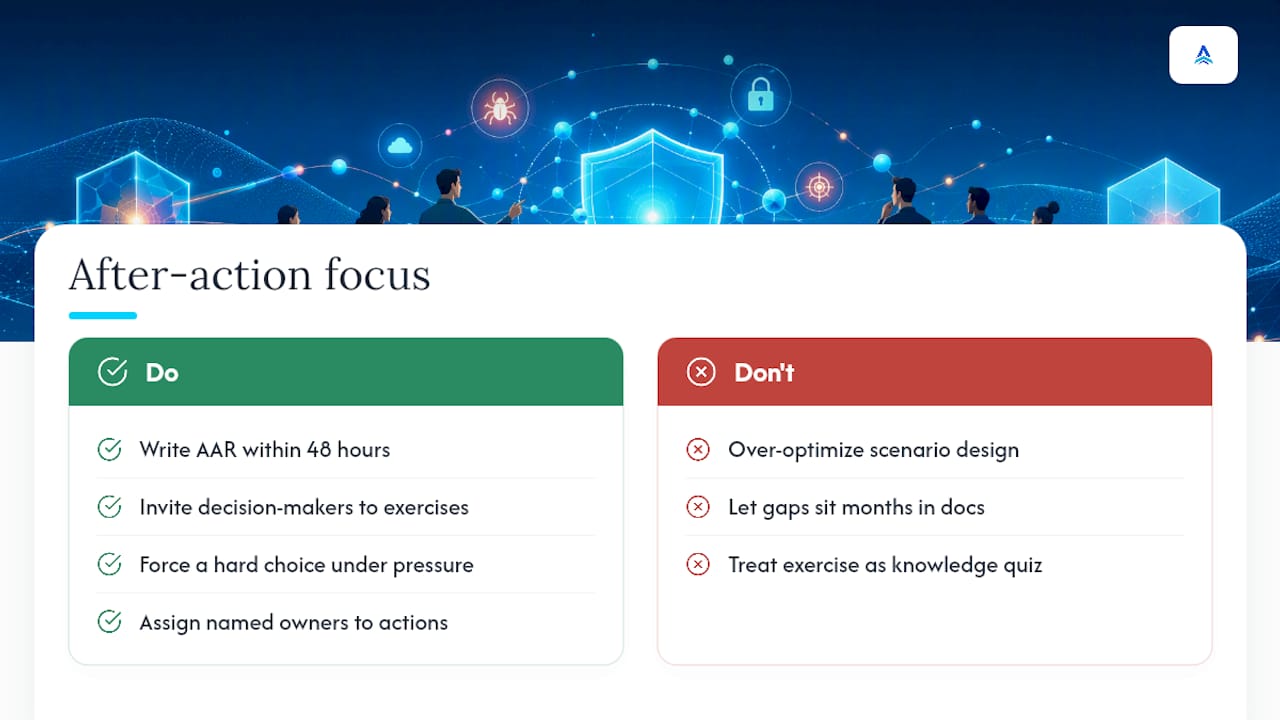
The conventional wisdom oversells realism and undersells speed. Yes, use real vendor names and specific dollar figures. But the exercise that matters most is the one where the AAR gets written in 48 hours, not the one with the most elaborate scenario. Organizations that treat the tabletop as a decision-making test, not a knowledge quiz, get more out of every session: they invite people with actual authority, they force a hard choice under time pressure, and they walk away with named owners instead of vague action items.
If you take one thing from this: stop optimizing scenario design and start optimizing your after-action turnaround. A mediocre scenario with a fast, disciplined AAR beats a brilliant scenario that nobody follows up on.
— Tyson
Get Professional Tabletop Facilitation From ArchiTECH
Running your first tabletop internally with a CISA template is a solid start, but an outside facilitator catches the blind spots a team can’t see in its own environment. ArchiTECH is the alternative to muddling through alone: our engagements pair a custom scenario with a facilitated 90 to 120 minute session and a prioritized remediation plan after the session.
Start with a free cybersecurity assessment to identify where your current incident response plan has gaps before you even schedule the exercise. From there, our cybersecurity services team can facilitate the full session, write the AAR, and hand you a remediation tracker with owners and dates already assigned. Request the assessment today and get a specific read on where your organization stands.
Sources
- CISA Tabletop Exercise Packages
- Tabletop exercise - NIST CSRC glossary
- How to run a ransomware tabletop exercise | P.K. Sharma
FAQ
What Is a NIST Tabletop Exercise?
NIST defines a tabletop exercise as a discussion-based activity where personnel with defined roles meet to validate response plans by talking through a simulated scenario, rather than physically executing response actions.
How Much Does a Tabletop Exercise Cost?
Cost varies widely based on whether you run it internally using a free template like CISA’s CTEP or hire outside facilitation; ArchiTECH offers a free cybersecurity assessment to scope a custom facilitated engagement for organizations that want professional support.
What Is an Example of a Tabletop Exercise?
A common example walks a leadership team through a ransomware attack: encryption is discovered, IT reports a nine-day restore estimate, and the group must decide whether to pay, how to communicate externally, and who authorizes each step.
Who Typically Participates in a Cybersecurity Tabletop Exercise?
Effective exercises include an executive sponsor, incident lead, IT and security staff, legal counsel, a communications lead, and often a finance representative, with a facilitator and scribe running the session and capturing findings.
Recommended
- Free Cybersecurity Assessment
- Cybersecurity Services for SMBs
- Backup & Disaster Recovery
- Ransomware in New England: Why Local Businesses Are Targets