Here’s the honest number: a small SAQ A merchant should budget somewhere in the low thousands of dollars per year in ongoing costs, a mid-size business validating through SAQ D or a Report on Compliance often lands in the tens of thousands, and a large enterprise running a full ROC engagement can see hundreds of thousands annually. The real driver isn’t your industry or your revenue. It’s how much of your environment sits inside PCI scope. Your first move: figure out your SAQ type and get two or three vendor quotes before you assume anything about price.
TL;DR:
- PCI compliance costs vary mainly based on your validation route, with small businesses spending in the low thousands annually, while large enterprises may spend hundreds of thousands.
- Using tools like tokenization and hosted payment pages can reduce scope and cut total costs by up to 60 percent, especially by eliminating entire control categories.
- First-year expenses are higher due to remediation work and scope discoveries, with ongoing costs primarily related to scans, testing, and maintenance.
- Penetration testing and remediation are the largest first-year cost drivers once your environment exceeds SAQ A scope.
- Continuous security management reduces surprises and lowers long-term costs by maintaining controls proactively rather than reacting just before audits.
What Drives PCI Compliance Cost: Merchant Level and Validation Route
Your PCI compliance cost is decided almost entirely by which validation route you’re required to use, and that route is determined by your merchant level and how your business handles cardholder data.
Visa, Mastercard, and the other card brands sort merchants into four levels based primarily on annual transaction volume. Most small and mid-sized businesses fall into Level 2, 3, or 4, which typically means you self-assess using a Self-Assessment Questionnaire (SAQ) rather than hiring a Qualified Security Assessor (QSA) for a full audit. Level 1 merchants, generally those processing over six million transactions a year, are required to complete a formal Report on Compliance (ROC) conducted by a QSA.
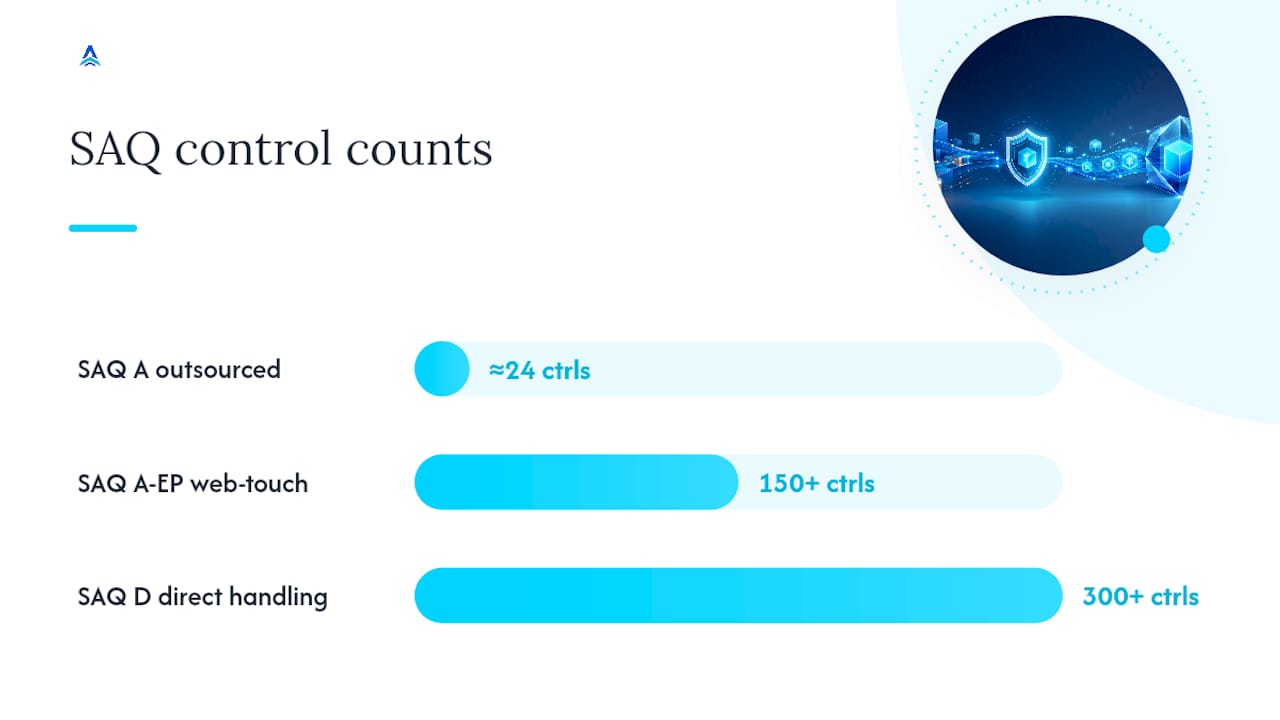
The SAQ type you use depends on how you accept payments, and the control count differs dramatically between them. SAQ A, built for merchants who fully outsource card data handling to a validated third party, covers roughly two dozen requirements. SAQ A-EP, used when your website touches the payment page even without storing card data, adds significant scope, often 150 or more controls. SAQ D, the catchall for merchants who store, process, or transmit card data directly, covers the full PCI DSS control set, over 300 requirements under PCI DSS v4.0.1.
Timelines track scope. A clean SAQ A business can often finish in a few weeks. SAQ A-EP or SAQ D efforts commonly stretch weeks to several months, especially with remediation involved. A full ROC engagement, with on-site QSA work, evidence review, and report drafting, typically runs several months from kickoff to signed attestation. That timeline gap explains why first-year costs almost always exceed what you’ll pay in renewal years. Once you’ve closed initial gaps, ongoing costs mostly cover scans, testing, and maintenance rather than rebuilding your environment from scratch.
The Seven Cost Components Behind Every PCI Compliance Bill
Every PCI program, regardless of size, breaks down into the same seven cost buckets. Understanding each one lets you see exactly where your money goes and which levers you actually control.
- QSA assessment and readiness work. Gap analysis, on-site assessment days, and report writing. Required for ROC-validated merchants and often used voluntarily by SAQ D businesses that want expert guidance before self-attesting.
- ASV scanning. PCI DSS v4.0.1 Requirement 11.3.2 mandates four passing external vulnerability scans per year from an Approved Scanning Vendor. Cost scales with the number of external IP addresses in scope.
- Penetration testing. External, internal, and segmentation testing, required annually and after any significant infrastructure change.
- Security tooling. SIEM, file integrity monitoring, and web application firewalls, plus GRC or evidence automation platforms that track control status year round.
- Remediation project work. Network segmentation, encryption key management, data loss prevention, and infrastructure hardening. This is frequently the single largest first-year cost.
- Internal staff time. Hours spent gathering evidence, coordinating with vendors, and managing the assessment. This rarely shows up on an invoice, but it eats real payroll capacity.
- Training and vendor management. Annual security awareness training plus tracking Attestations of Compliance from every third-party service provider touching card data.
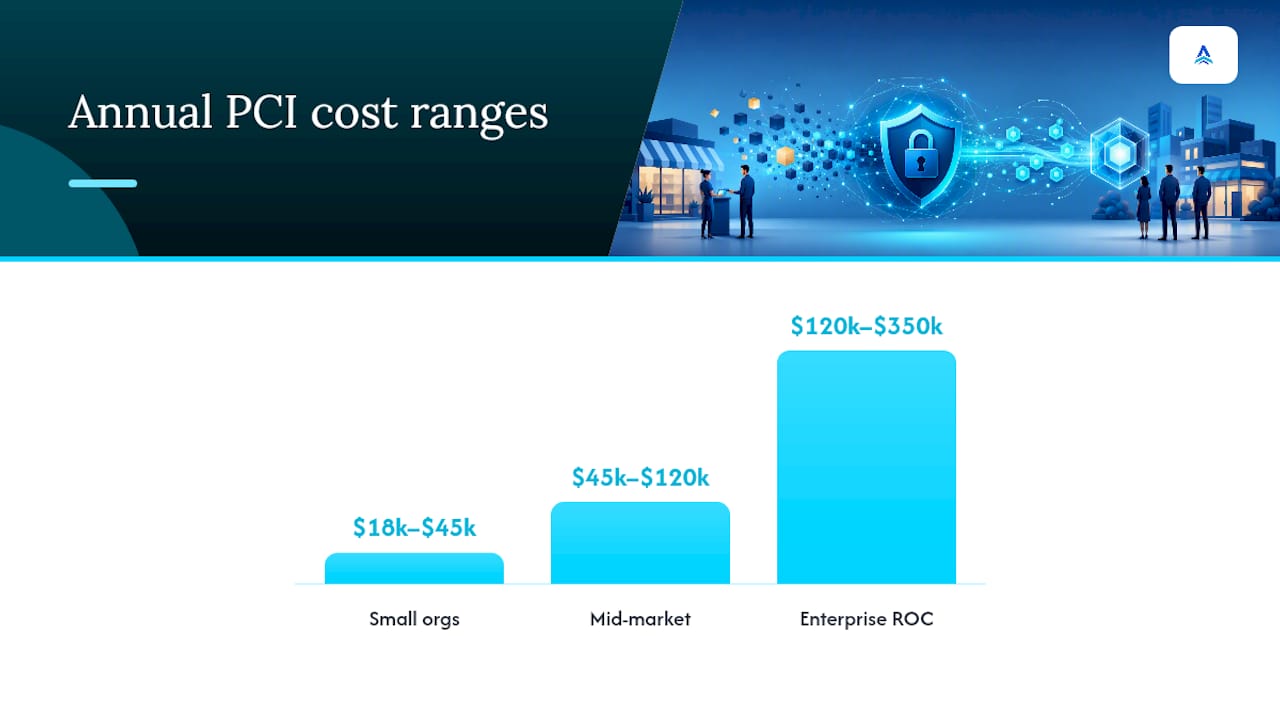
Benchmark data from industry surveys puts small organizations in the $18,000 to $45,000 range annually, mid-market businesses between $45,000 and $120,000, and enterprise ROC programs anywhere from $120,000 to $350,000 or more depending on scope and tooling maturity. Penetration testing and remediation are consistently called out as the biggest line items once a business moves past SAQ A.
Pro Tip: Ask every vendor quote to separate one-time remediation costs from recurring annual fees. Businesses that lump them together almost always underestimate what year two actually costs.
How Do You Estimate Your Own PCI Compliance Cost?
No QSA, acquirer, or ASV publishes a flat rate card for PCI work, because your cost is a function of your specific scope, not a universal price point. The only reliable method is a quantity-based worksheet: multiply the frequencies PCI DSS requires by the rates your vendors quote, then add internal labor and a remediation cushion.
- List your required quantities. Four ASV scans per year, one to two penetration tests, SIEM licensing sized to your log volume or endpoint count, and training seats for every employee handling card data.
- Collect vendor rates for each line. Get quotes for ASV scanning, pen testing, and SIEM or evidence automation licensing.
- Multiply quantity by rate. This gives you your recurring cost baseline before remediation.
- Add internal labor hours. Smaller teams often spend 40 to 80 hours a year on evidence and coordination; mid-size teams can spend several hundred.
- Add a remediation contingency. First-year businesses should budget extra for gaps discovered during assessment, since almost nobody passes clean on the first pass.
When comparing vendor quotes, ask each one to define scope explicitly, disclose whether failed scans include free retests, and list exactly what deliverables you’ll receive. A quote that looks cheaper often assumes a narrower scope than a competing quote, which makes the two impossible to compare honestly.
Practical Ways to Lower Your PCI Compliance Expense
The single biggest lever is reducing what’s actually in scope. Every control, scan, and test you avoid because card data never touches your systems is a cost you never pay.
- Use hosted payment pages or tokenization. Routing card data through a validated third party can qualify you for SAQ A instead of SAQ D, cutting your control count by an order of magnitude.
- Add DTMF masking for call centers. Keeps card numbers spoken over the phone out of scope for recording and storage systems.
- Automate evidence collection. Platforms like Sentrix’s PCI DSS automation tools cut the manual hours spent chasing screenshots and logs every quarter.
- Convert tooling into managed OPEX. A co-managed SIEM arrangement turns a capital tooling purchase into a predictable monthly line item.
Descoping through tokenization and hosted payments typically cuts total program costs by 35 to 60 percent or more, because it removes entire categories of testing and tooling requirements rather than just shrinking them. Automation delivers a smaller but still meaningful cut, with benchmark studies attributing 30 to 45 percent labor savings to organizations running continuous monitoring instead of manual quarterly evidence pulls.
Pro Tip: Before signing any hosted payment or tokenization contract, confirm your acquirer’s own Attestation of Compliance requirements. Outsourcing scope doesn’t outsource your responsibility to track that vendor’s compliance status.
Common Hidden or Unexpected Costs That Might Arise
Budgets built from a QSA quote alone almost always miss the costs that surface mid-project.
Rescoping surprises hit businesses that assumed a simple architecture and discovered mid-assessment that a legacy system or a forgotten integration pulled card data into a system nobody accounted for. That single discovery can push a business from SAQ A-EP territory into full SAQ D scope overnight.
Failed scan retests are another quiet expense. ASV scans that fail on the first pass often require a paid retest, and businesses running lean infrastructure sometimes fail two or three cycles before passing clean.
Segmentation validation gets skipped in early quotes but becomes mandatory once your network touches multiple zones, adding a specialized testing line that many first-time budgets never anticipated.
Employee turnover during the assessment window forces you to retrain new staff on evidence-gathering procedures mid-project, adding hours nobody planned for.
Third-party vendor gaps show up when a payment processor or hosting partner can’t produce a current Attestation of Compliance, forcing you to either switch vendors mid-cycle or absorb additional scope internally. Building a 15 to 20 percent contingency into your first-year budget covers most of these surprises without derailing your timeline.
Why Treating PCI as Security Strategy Lowers Total Cost
The businesses that spend the least on PCI over time are the ones that never treat it as a once-a-year scramble. ArchiTECH MSP builds every client engagement around a six-step security framework that keeps HIPAA and PCI controls maintained continuously, not assembled the week before an audit. That approach, cuts QSA days and internal hours because evidence already exists instead of being reconstructed under deadline pressure. Framing compliance as continuous risk management rather than a compliance event is what actually keeps remediation surprises off next year’s budget.
— Tyson
Get a Tailored PCI Compliance Cost Estimate From ArchiTECH
Most SMBs don’t need a bigger audit budget. They need fewer surprises inside the one they already have. ArchiTECH MSP’s compliance readiness assessments start with a gap analysis against your actual scope, not a generic checklist, so your remediation plan targets what’s really driving cost.
From there, our team coordinates penetration testing, stands up continuous evidence automation, and manages the remediation project work that typically eats the biggest chunk of a first-year budget. If you’re trying to figure out where your business actually falls, whether that’s a lean SAQ A path or a full ROC engagement, request a free cybersecurity assessment and we’ll help you build a real, line-item PCI cost worksheet based on your environment instead of a guess.
Sources
- PCI Compliance Cost 2026: Level-by-Level, No Vendor Pitch
- PCI DSS Audit Cost Report 2025 | Industry Benchmarks | GRCTrack
- Cost of PCI Compliance in 2026: The Real Numbers
- Stripe resources on PCI compliance cost
FAQ
How Much Does PCI Compliance Cost for a Small Business?
Small SAQ A merchants should budget somewhere in the low thousands per year in ongoing costs, with first-year expenses often higher due to remediation work.
What Is the Average PCI Audit Cost for Mid-Size Companies?
Mid-market businesses validating through SAQ D or working with a QSA generally see $45,000 to $120,000 annually, with penetration testing and remediation as the largest line items.
Does PCI DSS v4.0.1 Change How Often I Need to Scan?
PCI DSS v4.0.1 requires four passing external vulnerability scans per year under Requirement 11.3.2, plus annual penetration testing and additional testing after significant infrastructure changes.
Can Descoping Really Lower My PCI Compliance Cost?
Yes. Routing card data through hosted payment pages or tokenization can cut total program costs by 35 to 60 percent by removing entire categories of controls from scope.
Does ArchiTECH MSP Help With PCI Compliance?
Yes. ArchiTECH MSP runs compliance readiness assessments and ongoing managed security services built around a six-step framework designed to reduce remediation surprises and shorten time to compliance.
Recommended
- How to Choose a Managed IT Provider in MA
- Managed IT Services in New Bedford, MA